Foster the People - Helena Beat

Tuesday, February 19, 2013

Supernatural Strategies for Making a Rock'n'Roll Group


     Considering one of my main goals this year (& for the last 2 years) has been to create a rock band, this book title caught my eye while visiting Pitchfork.  Disregard the fact that I don't play an instrument currently, a book where I could learn some supernatural strategies that could then be put into play could probably help my predicament and goal for rock stardom; albeit on a slightly less ambitious scale.  To be honest, I would be happy with a gig at a local bar.


     The book Supernatural Strategies for Making a Rock 'n' Roll Group is written by punk enthusiast and musician Ian Svenonius.  Svenonius has been involved in the Washington D.C. music scene for a little over 25 years, with his start coming in 1988 with the outfit Nation of Ulysses.  Described as a Marxist and anti-autthoritarian (punk band remember), his music and writings veer off into a realm of philosophy that would be safe to say is not shared by most people at your work place.  If that were the case though, then Svenonius would probably need to change it up and rage against another type of machine.


     With that said, Svenonius centers his new book on reporting the advice and wisdom given to him by dead rock stars through seances to find out the basic how-to's of forming a rock band.  According to Svenonius, "I tried to interview living people who I thought would be of help, but I really got no satisfaction from these establishment characters that I talked to.  Because of that, I had to resort to speaking to the dead, and I found they has less political motivation to spin things in any particular direction.  And they had lost their fear of insulting the living, so I got a lot of really honest feedback from the ghosts" (1).


     Naturally, the question for most readers would be, is he serious?  Fair enough, writer David O'Neal of the Los Angeles Review of Books wrote a great review of this book and commented, "Svenonius acts as an enervated docent in the rock 'n' roll hall of fame, more interested in torching the wax dummies around him than in getting them to speak.  And Svenonius is not a very skilled ventriloquist, anyway, or, really, he's not trying to be.  (For example, this is from a surprisingly sober and analytical Jim Morrison: "Surf groups exploited actual surfers and objectified them as fetish dolls in order to give the lost and desperate post industrial teenyboppers of Southern California - and via them the entire teenage nation - an identity").  So, the seance joke soon sputters.  Svenonius's autodidactic prose style, his dazzling jump cuts, and his glib-serious tone sounds off-key when it's (supposedly) filtered through a dead icon.  Brian, Buddy, and Jimi all sound like Ian - and he's the one we want to hear from, anyway" (2).


     So, it's safe to say that the advice and insight presented in this book are not that of Jimi Hendrix's or Buddy Holly's ghost.  What is the book about then?  Well, really what the title states, startegies for making a rock 'n' roll group.  I was able to read 3 chapters from the book online, each with a rather non-extraordinary title.


     One chapter is dedicated to the discussion of how one should determine goals in a rock band, how to practice and hold rehearsals, and finally how to prepare for performances.  On determining the goals one should have in a rock band, Svenonius states there are generally four goals that most people have in forming a rock band: (a) to be famous, (b) sexually popular, (c) to write songs in the style of another particular group and (d) to advance a particular ideological system.

     On the goal of starting a rock band to become sexually popular, "If b), to be an amorist, is your goal, give up the group as a means to carnal buccaneering.  The best thing for you is to pursue a job in advertising, medicine, or the field of "law".  These professions are celebrated by televised propaganda (in programs such as Law & Order, Grey's Anatomy, and Mad Men), and will provide you with the financial incentives - in the form of real estate, luxury cotton sheets, and perceived stability - required to seduce your prey..." (3).


     Now, I left off the last part of the quote because it went on to rant against a "capitalist society" with the implication that some how being an amorist, one who is dedicated to sexual love, necessarily entails that one live in a capitalist society.  I can't for the life of me see why that would be considering one living in say a Communist regime could equally be dedicated to the pursuit of sex (I just want to toss out to all my friends who work for the government, Yay America! Yay Capitalism! Haha).


   As you can see, of course, these seemingly mundane sections on determining goals, band practice, and performances take on a more lively tone due to the interesting and unique thoughts offered by the author.  If you weren't paying attention in that last passage, the aim of the book isn't so much to just offer practical advice on how to form a rock band but more as a medium in which to share an ideological viewpoint.

     Reading just 3 sections of his book, I can say that Svenonius views are not my own, but I still found the writing interesting and did find points of agreement with him even though they were from a very different perspective.  Take the following passages for example from the three sections I was able to read:

"The change you will effect using a group is not unlike a magic spell.  Whatever your intention, your conjuring will invoke something deformed and accidental.  It will unleash uncontrollable forces or it will snowball slowly, insidiously, into something monstrous that will torment you for eternity."

"Therefore, if your group is fervently ideological, aware of the implications of its aesthetic presentation, and committed to its cause, it will be almost unbeatable.  This kind of faith is hard to muster in our blase, cynical, intellectually paralyzed, narcissistic, pornoholic, and postideological word..."

"Because the group is not really about music - it's a model or an ideal.  All life is practice when one is "in" a group...One must learn to be as directly indirect, unselfconsciuosly self-aware, poetic, loose, dynamic, and charming offstage as one is when one is "treading the boards."  One must delight, captivate, entrance, and seduce whether one is in the coffee shop, sitting room, or the office cubicle" (3).


     Lets see, how can I sum up those last three passages.  Obviously the focus is on the concept of a "group".  According to the passages, a group can be extremely powerful, unleashing accidental effects that can be either positive or negative.  A group that is committed to a cause to the point of faith is almost unbeatable and rare.  Finally, life is really a study of how to interact within a group, with the caveat that a person's individuality might become secondary to the group or enhanced (can't quite tell from the last passage - concern might lie in the fact that personal behavior is often a show for the group and not necessarily true or genuine).

     Ok, got it...check...let me start that rock band now lol.  If I picked up anything from reading Supernatural Strategies for Making a Rock 'n' Roll Group, it's the sense that a group or being a part of a group is some how intrinsically bad.  If I had to disagree with a major implication or rant of the author it would be about that point.  For as long as a group strides for the common good and is aware of its unique pieces for that mission, then the ugly mechanistic and cruel depiction of a group is lost.

     On last note before I wrap up this post that started out about discussing the advice a person was said to have received from dead rock stars.  This is a quote from Svenonius:

"A rock 'n' roll group should not be respectable, nor should it be bourgeois or prestigious.  If it's to retain any power or any threat, its status must hover somewhere between that of the vagrant, the doomsday prophet, the street urchin, and the prostitute" (4).


     Funny enough, I agree.  The best artists, whether they be dead or alive, have always sought to tell the stories of the downtrodden, weak, abused, and hopeless.  For in those stories the group's power would become manifest, freeing the individual from the chains that bind them, if only for a brief moment in time.  All courtesy of, you guessed it, a group.

Saturday, January 26, 2013


Paul Banks – ‘The Base’ – from the album Paul Banks

So here’s some semi- new music courtesy of Paul Banks aka the lead singer of Interpol aka Julian Plenti.


This is Paul’s second solo album in 3 years.  The album preceding this release was 2009’s Julian Plenti is…..Skyscraper.  His second effort has a less pretentious album title, it simply is Paul Banks, but there is a reason he chose to drop the Julian Plenti moniker.

Here is an excerpt from an interview with Paul conducted by FaceCulture (The whole interview can be found on Youtube):

“I never really pegged myself or looked at myself as a performer.  I think I like making art but the performance side of things was always a little strange for me….so I kind of gravitated in the early days to having an alter ego and a stage name and sort of trying to inhabit that idea of a public face to the art….Before Interpol even got off the ground, I was using that stage name.  I almost used my stage name in Interpol and then the band kind of collectively decided we would all use our real names but I was going to be Julian Plenti in the band."

"The reason why I did my 1st record as Julian Plenti was because I basically, I had these songs before the band..and I just kind of left them there….I was originally going to be a solo artist and then I kind of got seduced into being in this band because I loved what they were doing.  I told myself at the time that I joined Interpol, you need to come back to this and finish what you started..because this is really your identity."

"As far as why not on this one [record] is because with the exception of ‘Summer Time is Coming’, there is no music on this record that dates back from that period….The first record had to be that because they were Julian Plenti songs.  These songs are just my most recent material, and I just felt it would be a little forced for me to continue with the alter ego for this record.”


A quick listen to ‘The Base’ should remind listeners and fans of the music from Interpol, simply because of Paul’s voice.  However, it would be a mistake to quickly throughout Paul’s songs as Interpol lite.  Paul does attempt to create his own sound and the listener can judge how well he succeeds. 

Like Interpol, this music does find Paul singing songs about his prevalent malaise.  It would be unique if one day something great happened in Paul’s life where his music would reflect a more upbeat attitude, however, such is his art and it is what fans have come to expect from him.

As a fan of Interpol, I much rather prefer the work Paul has done in that band and I feel nothing in his solo records come close to touching the greatness found on Interpol albums like Turn on the Bright Lights and Antics.

With that said, enjoy the song and Part 3 of the FaceCulture interview.


Thursday, August 23, 2012


You can’t go home again
This popular phrase was one I heard a lot and internalized while growing up.  I would often repeat it to my dad at his dismay; his thinking being that I shouldn’t believe the statement because that would eventually lead me to leaving home and never coming back.  Low and behold I have been in Baltimore for three years now.

With no idea where life will take me at this point (Baltimore, Ohio, a yet unknown destination) I can understand why my dad would try to encourage me not to buy into the sentiment of the phrase; his hope being that he could keep his kids around the home he was able to build.  I still have a strong desire for my family to one day be together again, with my parents fulfilling their duties as grandparents while my siblings and I share in each other’s lives as we raise families and grow old together.  But life is bound to take unexpected turns and I fear I am not in complete control and can only do my best.
                                                

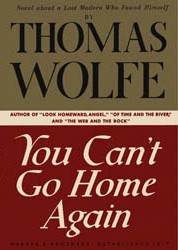
This phrase, for those who don’t know, is from a book by Thomas Wolfe published in 1940 that was written to explore the changing of American society in the 1920s/30s through a work of fiction.  The phrase then, “You can’t go home again” is meant to express the idea that the flow of time forever changes everything around us and that ‘going home’ or hoping to relive past moments and memories is an impossible feat.  Time will always and forever keep moving forward, changing people and places so radically that nothing in our past can be relived again in the present or future.  The best way forward then would be to create a home of your own instead of trying to go back to the one in which you came.

This leads me into my review of the album Arrow released earlier this year by the Heartless Bastards.  Arrow is the 4th album from this band and it is essentially an exploration into the idea of ‘Going Home’.  Formed in 2003 in Cincinnati (O-H!), the Heartless Bastards released their first record in 2005 titled Stairs and Elevators, their 2nd in 2006 titled All This Time, and their 3rd in 2009 titled The Mountain.


I haven’t had a chance to dig into their earlier work but their sound from those years has been described as a gritty, garage type blues.  Think The Black Keys (I-O!) but with a female lead singer, more guitars, and a mix of country, blues, hard rock, and some psychedelia thrown in.  On Arrow, you can definitely hear the influences all those different types of genres. 

Upon my first listen I was impressed with the classic rock and hard rock elements; hearing great rock riffs on guitars is unique in this day and age but there are several songs on the album that give the listener that thrill.  Arrow also has songs that are both contained and expansive in scope.  However, whether contained or expansive, the instruments used to convey the emotions are standard for a throwback type of rock band; drums, bass, rhythm and lead guitar.  You won’t hear any electronica or strings on this album; to the joy for some or detriment to others.


The Heartless Bastards are led by singer-songwriter/guitar player Erika Wennerstrom who has been the only constant in the line-up of this band since their formation in 2003.  She is joined on the record Arrow by bassist Jesse Ebaugh, drummer Dave Colvin, and guitar player Mark Nathan.  Before the creation of 2009’s The Mountain, the original line up of the Heartless Bastards broke up.  This is important to know because former bassist Mike Lambig had a nine year relationship with Wennerstrom and the break-up of the original band members coincided with Lambig and Wennerstrom parting ways personally.  But if Fleetwood Mac has taught us anything, it’s that breakups between members in a band can lead to good music.  Most of the songs off The Mountain detail the emotions and experiences of Wennerstrom after the end of her nine year relationship to Lambig.


Arrow then picks up where The Mountain left off.  “The Mountain was me going through some things after being in a relationship for nine years,” Wennerstrom says.  “This album is kind of like me being comfortable again.”  The pursuit of becoming comfortable once again led Wennerstrom to visit friends and family in Ohio (She grew up in Dayton), visiting the Catskills, spending time alone in Arkansas, a lake cabin in the Allegahny Mountains, and a ranch in West Texas.  “I take a lot of trips to West Texas, and I’m very inspired by the landscape… I feel like there’s a lot of space on Arrow and lots of songs that were inspired by staying on a friend’s ranch out there. There’s space in the music and space in the land”, says Wennerstrom.


This wanderlust that Wennerstrom undertook can best be understood as a way for her to finally come to terms with the emotional crisis that she had to deal with during 2009.  The songs on Arrow paint this picture and also tie back into the theme of ‘Going Home’; home in this sense being an emotional place where she can finally let go of the past and find peace and security.  The song ‘Marathon’ starts the album off with Wennerstrom observing a marathon that is taking place inside the city limits and her thinking to herself “I ventured so far that I forgotten what I was running from, and time it takes you so far and I am longing to be back home”.

‘Parting Ways’ is the 2nd song on the album (the first single to be released off the album but thank God it isn’t the best song on the album as my First Single Hypothesis states that if any albums best song is its first single, then that album is shit; hasn’t failed yet).  Check out the music video for ‘Parting Ways’ as it is sure to get a chuckle even though the artistic aim isn’t very high. 


The first great song off Arrows is ‘Only For You’.  ‘Only For You’ is a mysterious song filled with a very nervous and cautious excitement.  “I just don’t know what to do, my head is such a cloud, I’m so tired of trying….it’s been a while since I felt this way about someone….I will open my heart, only for you”.  And this is where the contrast in songs off Arrow is first noticeable. 


It seems half of the songs on the album attempt to tackle the major themes of the album with songs that fit the mood of searching for a home (contemplative, melancholic, anxious, hopeful) while the other half of the songs are distracting as the moods they capture (which is to say they really don’t capture any certain mood and are just very bland) has the effect of giving a jarring transition to the ears from the main songs on the album.  ‘Parted Ways’, ‘Got to Have Rock and Roll’, ‘Simple Feeling’, and ‘Late in the Night’ are all culprits.  For me, they didn’t add anything to the album and I usually skip them to listen to the other songs on the album.

Other stand out songs that join ‘Marathon’ & ‘Only For You’ include ‘Skin and Bones’ and ‘Low Low Low’.  By far though, the two most important songs on this record are ‘The Arrow Killed the Beast’ and the last song on the album, ‘Down in the Canyon’.  If you really want to know what the album Arrow is about and the emotions of Wennerstrom as she tries to overcome the fall out of her nine year relationship and all that entails and find her ‘home’, then listen to these two songs.

Both are the darkest and melancholic songs on the album but at the same time the most impactful and real.  ‘The Arrow Killed the Beast’ describes the metaphorical killing of a beast; the beast being a psychological state inside Wennerstrom.  The main question then is what is the arrow in the song that she is referring that finally kills the beast inside of her, “A simple life out here in the country where the sky is full of mystery….why don’t we go out, why don’t we head towards the sun.”  Open to interpretation for sure.


‘Down in a Canyon’ closes the album on what first seems like an unpleasant note.  Prior to ‘Down in a Canyon’ is the song ‘Low Low Low’, which (even though you can’t tell from the title) is an up-beat, happy song.  In ‘Low Low Low’ the listener is led to believe that Wennerstrom has successfully killed the beast and exorcised her demons and all is well in the bright sunshine, “I’m feeling the sun so warm on my skin, things are turning around again”. 


When ‘Down in a Canyon’ starts the scene is completely different.  No longer are you traveling in the warm sunlight of the day, but instead you are traveling through the darkness of a canyon.  Soon you find out by listening to the song that even though the beast may be dead, there are certain moments of silence and solitude where the memory of the beast comes through, “All this time we never saw the sun and now I’m back here again”.  However, unlike the past, this feeling is fleeting in nature and “I have one less ghost in my heart and things are turning around again.  And it feels like I never allowed you to let go…and now I, I will be home tomorrow”.

The greatest strength of the Heartless Bastards, as with any good band, is the ability of the band to be real and honest.  Wennerstrom’s songwriting is never so over the top or complicated to have the average listener not be able to connect to a song, nor is her song writing so simple that is doesn’t require the listener to think.

“I wanted to be in Akron when I was young”…..Wait!....What?....She wrote that lyric?  Never mind, take back everything I just wrote.  That is a complete lie.  No one would ever want to live in Akron lol.

Heartless BastardsArrow 6.5/10